All over the world, social distancing and restrictions on personal freedom are two important strategies to prevent the spread of Covid-19 coronavirus. Public gatherings are forbidden throughout national territories and mobility is restricted, being allowed only for a limited number of emergencies and towards a very limited number of destinations.
In order to help authorities to implement national and local policies to combat Covid-19, Google is currently creating reports based on aggregated and anonymized data, charting movement trends over time by geography and across different categories of places that can provide insights “into what has changed in response to policies aimed at combating COVID-19”.
The following can be read on the Google website: “this information could help officials understand changes in essential trips that can shape recommendations on business hours or inform delivery service offerings. Similarly, persistent visits to transportation hubs might indicate the need to add additional buses or trains in order to allow people who need to travel room to spread out for social distancing. Ultimately, understanding not only whether people are traveling, but also trends in destinations, can help officials design guidance to protect public health and essential needs of communities.”
Few days ago, Google released an anticipation of these reports including national and regional data. The places of interest considered by Google are “retails and recreation”, “groceries and pharmacies”, “parks”, “transit stations”, “workplaces” and “residential”.
Table 1 shows the results for Italian Regions and the figure 1 gives a visual illustration of Calabria (Italy) (here a short note for Italy in Italian). Tables 2 and 3 report data for a selected sample of countries (France, Germany, Spain, Sweden, UK, USA, Canada and South Korea) and some urban areas and provinces (Berlin, Île de France, Stockholm County, Greater London, New York, Ontario and British Columbia).
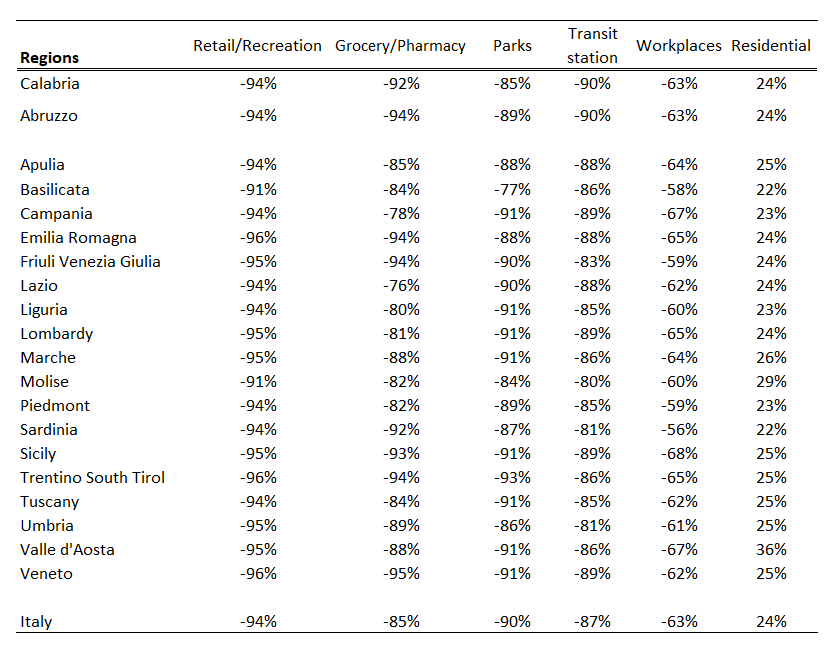
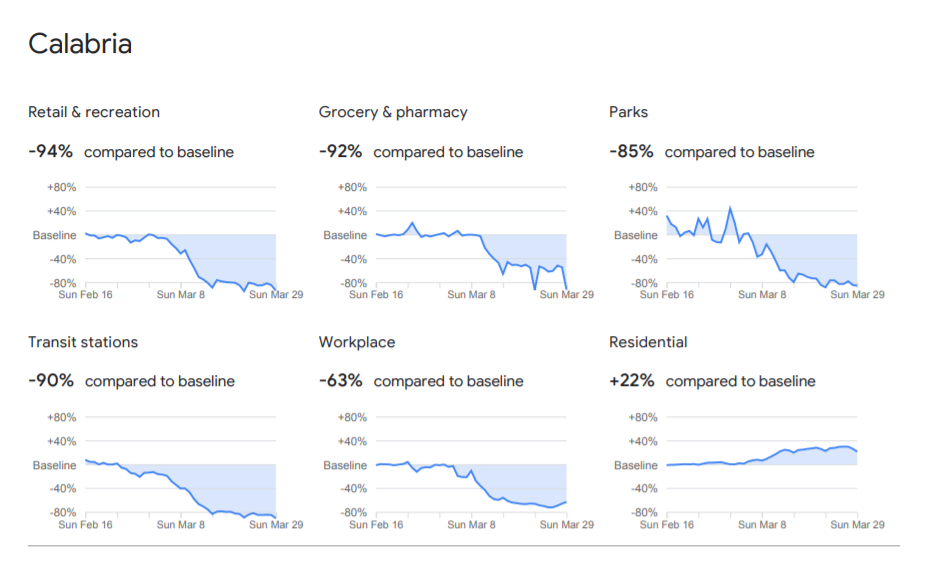
Results for Italy. As far as Italy is concerned, Google traced mobility for a period spamming from February 16th to March 29th 2020. If any policy ensuring social distancing is effective, then a significant change in the trend of mobility will be expected to occur. Google’s location mobility for any italian region illustrates the extent of the change from lockdown measures applied to the population. For instance, in Calabria on March 29, mobility for shops and recreational activities (e.g., bars and restaurants) decreased, compared to the baseline, by 94%; by 92% for pharmacies and food stores and 85% for parks. In addition, regional mobility “traced” by Google to Transit Stations decreased by 90% and that from home to workplaces by 63%. Finally, lockdown and quarantine directives lead to a 22% increase in residential activity.
Results for Calabria overlap Italy as a whole with regards shops and recreational activities, work and residential. While, visits to pharmacies and food decreased more in Calabria than in Italy (-92% against -85%), as well as mobility at transport stations (-90% in Calabria against the Italian average by -87%). Movements to parks have decreased the most in Italy (-90%). Here, it is worth describing data for Lombardy, which remains the european region hardest hit by the virus. Google’s data for Lombardy show a 95 percent drop in retail and recreation activity versus the pre-coronavirus period; a 81% drop in grocery & pharmacy; and a 12% increase in visits to parks.
Google’s results for a selected sample of EU countries. Many EU member States have implemented restrictions to transport but not all of them are the same for period or limitation (see here the Measures in the field of mobility implemented or announced by Member States in response to the COVID-19 pandemic).
Among the countries hard-hit by Covid-19 there is Spain that shows a 94% drop (versus the pre-Covid period) in retail and recreation activity, a 76% drop of mobility for places like grocery market and pharmacies, an 89% drop in visits to parks, -88% in transit stations (transport hubs like subway, bus and train stations) and -64% in workplaces. On the other hand, there is an increase of 22% of activity in residential locations.
Smaller decreases are reported for France in retail and recreation activities (-88%), grocery/pharmacy (-72%) and parks (-82%). A slightly bigger decrease is reported for workplaces (-56%). These results are in line with what is happening in the most populous french region, Île-de-France, which includes Paris.
Germany, on the contrary, is slowing down less than Spain and France: retail and recreation activities (-77%), grocery/pharmacy (-51%), parks (-49%), transit stations (-68%). Worth of attention is the 39% drop in workplace mobility and the 11% increase of activity in residential locations (50% percent more than Spain). Berlin’s results are very similar.
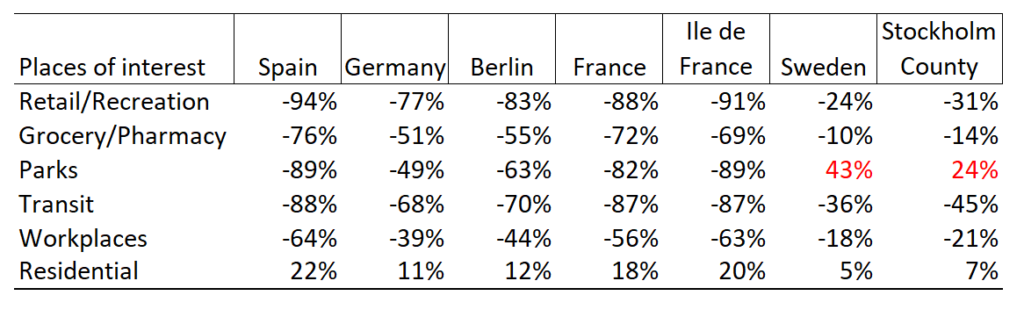
Despite the different impacts on mobility, while Italy, Spain, France and also Germany seem to have been taking seriously the restrictions on transport to cope with the spread of Covid-19, in Sweden, life seems to be carrying on as normal:
Google’s results show very small decreases in mobility: -24% in retail and recreation activities, -10% in grocery/pharmacy, -36% in transit, -18% in workplaces. It is very remarkable to note that, in striking contrast to the other European countries examined, Sweden shows a significant increase in visits to parks (among which dog parks, plazas and public gardens) reporting a +43% and a very smaller increase of activity in residential locations (+5%). These data are surely related to the fact that, currently, there are no restrictions except for unnecessary travel (“Recommendation to avoid unnecessary travel abroad”): in this case, precautions are left to people’s personal judgment.
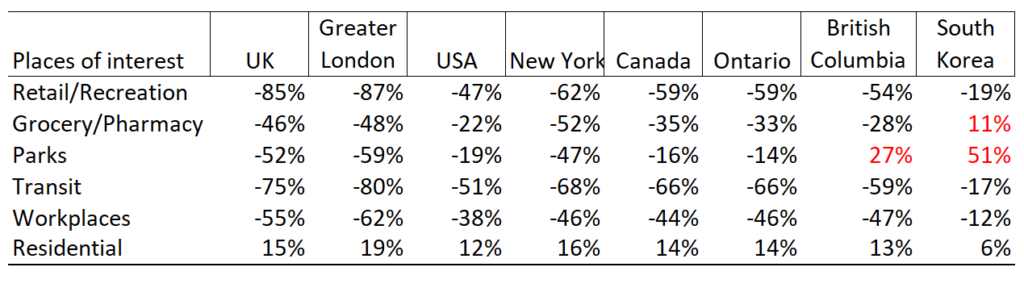
Google’s results for a selected sample of non-EU countries. It is noteworthy that, despite Boris Johnson’s early March Covid-!9 speech (providing very few recommendations and talking about not slowing the virus down too eagerly, in order to accomplish “herd immunity”), the UK’s mobility trends are quite similar to those of France with exception of grocery/pharmacy (-46%) and parks (-52%). The area of Greater London (which includes the City of London) is perfectly in line with the country as a whole.
Following the epidemic progression, USA and Canada’s fears of coronavirus outbreak are deepening and, therefore, also are the number of restrictions and the self-isolation practices. The plausible effects of closures, movement restrictions and other government actions in Canada lead to a 59% drop in retail and recreation activity, a 35% drop of mobility for places like grocery market and pharmacies, a 16% drop in visits to parks, -66% in transit stations and -44% in workplaces. On the other hand, there is an increase of 14% of activity in residential locations. Ontario (which includes Toronto and Ottawa) and British Columbia (one of China’s largest trading partners) are perfectly in line with these national data.
With over 114 thousand confirmed cases of the coronavirus discovered in New York (including more than 63 thousand in New York City), the mobility trends reported by Google show a bigger decrease in mobility within New York in comparison to that of the US as a whole, respectively: -62% against -47% in retail and recreation activity, -52% and -22% in grocery/pharmacy, -47% and -19% in parks, -68% and -51% in transit stations, -46% and -38% in workplaces. The increase in residential mobility is aligned: +16% in New York and +12% in all the States.
Finally, what is happening in South Korea? The country acted fast to combat Covid-19 taking widespread rigorous and intrusive measures. Reasonably, this explains why the mobility trends have decreased in a notably small percentage: -19% in retail and recreation activities, -17% in transit stations (from March 16th, South Korea started to screen all people arriving at airports, Koreans included) and -12% in workplaces. According to Google’s report, there is an increase of +6% in residential activities, while, in contrast to other countries, South Korea reports an increase in grocery/pharmacy mobility (+11%) and in visits to parks (+51%).